Birdman and Turkey Day

birdman-costume-birdman-new-trailer-dives-deep-into-a-washed-up-superhero-new-york-film-festival-2014-birdman-movie-reviewI finally saw the move Birdman, and I can’t recommend it enough. From the first to the last scenes, it’s an amazingly beautiful, provocative, dark, funny and even uplifting movie, in a weird sort of way. I won’t give anything away (here’s a good review if you want to know more about the story), but the movie struck me as being ultimately about how we’re all deluded about who we really are. Which made me think of this wonderful and unlikely quote from Albert Einstein:

A human being is a part of the whole called by us universe, a part limited in time and space. He experiences himself, his thoughts and feeling as something separated from the rest, a kind of optical delusion of his consciousness. This delusion is a kind of prison for us, restricting us to our personal desires and to affection for a few persons nearest to us. Our task must be to free ourselves from this prison by widening our circle of compassion to embrace all living creatures and the whole of nature in its beauty.

Worth keeping in mind as we approach the holidays.

Have a great Thanksgiving!


The Snark Defense

snark-warningSunday was graduation day for my coaching class. As I boarded the Q train to Manhattan, I was half dreading it. We’d all been asked to make a short presentation about what the program and our colleagues had meant to us. My immediate response was an eye-roll. I hate this kind of thing, I thought – the sappy language, the forced emotions. I managed to fulfill the obligation by finding a kind of clever, snarky poem I could read, and I did get a laugh. Job done.

But as I watched my classmates make their presentations, some of which involved heartfelt displays of acting, singing, dancing, personal poetry and videos, I realized once again that I’d taken the easy way out. And, I realized, I’d lost out in the process.

Hiding behind a wall of cynicism is not just something I do in coaching class. My response to frustrations at work, for example, has often been to withdraw, make snarky comments or otherwise join in a generally negative office atmosphere. While that’s protected me in some ways from taking disappointments personally, it’s also kept me from really engaging in a positive way with some of the really wonderful people who work there.

I don’t know if it’s because I was trained as a lawyer and a journalist, both professions where emotional distance and a critical eye are considered essential to doing a good job. (In the age of online journalism and social media, it’s even worse – the snarkiest posts get the most eyeballs.) Or maybe it’s the way I grew up – my parents were both doctors, another profession where emotional involvement is forbidden, and critical judgment prized.

Whatever the reason, the result is I’m not someone who displays deep emotions very easily. I always though that was helpful, at least professionally – no one wants to be caught crying in the office, for example. But increasingly, I’ve come to realize it’s also an impediment. Sure, I can come up with a snarky response on Twitter pretty quickly (though not nearly so quickly as some), but when it comes to face-to-face communication and connection, with co-workers, classmates or anyone else, it’s a barrier. I’ve also come to realize, mostly through coaching, that genuine connection with other people is something I really deeply value. My snarkiness has been getting in the way.

Not that criticism or sarcasm doesn’t have its place. As Alan Henry puts it in this post I came across: “There’s a difference between being occasionally sarcastic and a little derisive in your head, but when negativity becomes your default reaction, you have a problem.” Henry cites the “wake-up moment” of Anna Holmes, founding editor of Jezebel, who once tweeted:

https://twitter.com/AnnaHolmes/status/208306732949176321

Henry goes on to list all the bad things snarkiness and cynicism can do, including:

On Sunday, it mostly just made me sad.

As I watched my classmates belt out a song, recite their own poetry, or dance gracefully to music that brought tears even to my eyes, I realized that I’m the one missing out. 

Learning to become a coach has begun to crack me open. A year ago, I wouldn’t have had those tears in my eyes and I probably wouldn’t have realized what I’d missed. I would have just been relieved when it was over, and my unexamined tension relieved.

This time, as I sat through our graduation ceremony – a candle-lit, spiritual music-filled affair – I felt both grateful and a bit disappointed. Yes, I had completed the program and learned valuable skills as a coach and am now certified and eager to help others. That’s what I came here for. But by holding part of myself back, by maintaining some of my critical distance, I had in some ways kept myself from fully participating in the experience. As I looked around the room, I saw 34 amazing people who I’d come to know some really meaningful things about, but whom I hadn’t really come to know.

Maybe we never fully know other people, but I’m increasingly realizing that the more we open ourselves up to them, the more they open to us, and the more we share the world together. And that makes it a much less lonely – and far more fun – place to be.

I’m not going to be really hard on myself about this: we all protect ourselves in various ways, and I’ve always been on the shy side. Dramatic performance about my innermost feelings was not going to come easily for me. That’s okay.

And I’m slowly getting better. All weekend I was dreading that time at the end of the final class when everyone has to hug and kiss goodbye, worried no one would really care to say goodbye to me or that it would all feel fake and I would want to run and hide in the bathroom. Instead, I just took a breath and slowed down. I decided I would just be real. No one was watching me or expecting me to perform. So I could decide, who did I want to say goodbye to, and what did I want to say? I found that when I let myself actually face those feelings, I had a lot to say, to a lot of people: about how much I appreciated what they’d brought to the class, to me, and to the whole 9-month training experience. And it turned out, I genuinely felt, and wanted to express, that each one really brought a lot. And that I truly appreciated it all.

When I could let go of my shyness and fear and the snarky shell I wear over it, I could genuinely share what I was feeling. Unfortunately, I didn’t get a chance to connect with everyone I wanted to. But I did manage to hug a whole lot of them. And that felt great.

Respect Yourself

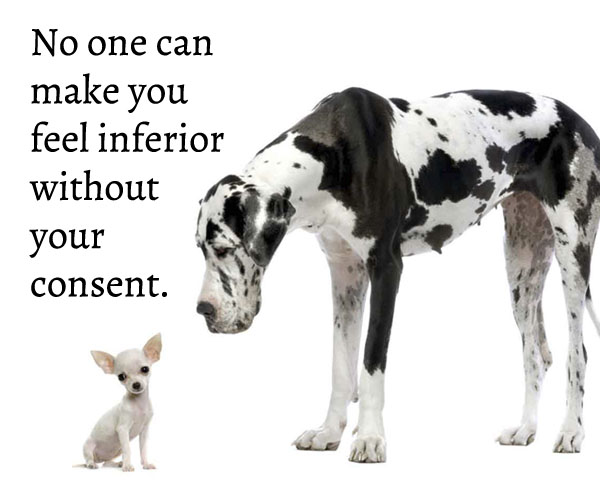
inferior-consent
I was at a company retreat a while back, one of those two-day events where management spends a lot of people’s time and the organization’s money having people participate in getting-to-know you exercises and breakout groups designed to make employees feel like their opinions about the organization’s work and direction actually matter. Everyone put on a good face and participated, at least half-heartedly, with the underlying understanding that nothing anyone contributed at the event would actually make any difference. After all, it never had before.

Just before the retreat ended, though, each department held a group meeting, at which employees could actually ask questions related to the work they really do.

That’s when sparks flew. One after another employee, from the most junior to the most senior (except the department head, who presided over the meeting), some with anger and some choking back tears, asked why it was so hard to get anything done; why decision-making by higher-ups was so opaque or nonexistent; why backbiting among staff had become the norm; and ultimately, what did the boss plan to do about it?

Not surprisingly, the boss, who has his own boss to answer to so ultimately couldn’t answer most of the questions, let alone solve the problems, had little to say. But what struck me was that under all of the complaints was one core problem: no one felt valued. Whether the complaint was that they didn’t receive timely responses to important questions, that necessary approvals for work to be completed never materialized, or that they were tired of another departments’ employees’ snickering comments, the upshot of it was that no one felt like the work they did was appreciated.

It was stunning to see: the same core problem had infected all rungs of the organization, from the most junior administrative staff to the most senior professionals.

This ties back to what I wrote in an earlier post: bosses aren’t there to make you feel good. Most of the time, they’re not thinking about you at all. They’re just thinking about what you produce and whether it meets their needs. If it does, they may or may not tell you that. If it doesn’t, you’ll hear about it – or it will trickle down to you in some fashion, because that’s what the boss is focusing on. But even if you’re doing great work, or the best you can, given the situation’s limitations, you may never hear about it. Managers are usually too busy focusing on all the things that aren’t working. And most bosses aren’t thinking about whether the people who report to them feel valued or good about their work.

That’s not a good thing, and I’m not making excuses for it. Organizations can and should do better. But ultimately, feeling good about your work is your job. And it’s important, especially if, like most people, you spend most of your waking hours working. If all it’s giving you is a paycheck, that’s a waste of a good chunk of your life.

This applies no matter what your job is. Whether it’s ministering to the poor, cleaning the office or running a company, it’s important to feel like you’re accomplishing something of value. And you can be. Even if no one ever tells you that.

The key is to set goals for yourself — and celebrate when you achieve them.

It’s something I’ve had to learn. When I was a journalist, it was easy enough: at the end of every project was a story that got published, and I had this tangible thing I could feel good about. I made sure I was always working on at least one story that interested me, so I could always feel like I was accomplishing something.

But when I joined an organization, it became much harder. Now that I was part of a larger machine, my work had to get approved by lots of other people before it could be completed. Much of it didn’t involve finished products with my name on them. And even when they did, I often felt like I didn’t get the credit I wanted for all the hard work I’d put into it, or the support I’d hoped for to ensure it made an impact.

It was on a leadership retreat that I learned the importance of setting my own goals and doing everything I could to meet them. I was choosing to meet them not because someone else expected or required me to, but because these were goals I had decided were important. When I met them – and when I set them myself, I usually did – I could feel really good about it. Eventually other people in the organization might have noticed, too, but what was important was that I knew I had a purpose that mattered to me, and I had fulfilled it.

Yes, it’s still annoying when you don’t get the recognition you deserve from higher-ups – and most managers need to do a far better job of letting employees know their work is important and appreciated. But if you value your own work, you don’t need to put nearly so much stock in winning the recognition of others. What’s important is knowing you’re accomplishing something that matters to you.

(And if you’re not, by the way, then that’s a whole other problem – to be addressed in a future post.)

What if Competence is Just a Mindset?

mindset-for-achieving-goalThere are a lot of reasons I love this recent story by Bruce Grierson — What if Age is Nothing But a Mindset? — that ran in the New York Times Magazine a few weeks ago.  If you missed it, it’s worth a read, if only for how it reinforces the power of our minds over our bodies and our perspectives on our lives and possibilities.

But there’s also this mention in there of a previous study by the psychologist Ellen Langer, the subject of the piece, that really struck me. Here’s Grierson’s description:

Langer gave houseplants to two groups of nursing-home residents. She told one group that they were responsible for keeping the plant alive and that they could also make choices about their schedules during the day. She told the other group that the staff would care for the plants, and they were not given any choice in their schedules. Eighteen months later, twice as many subjects in the plant-caring, decision-making group were still alive than in the control group.

I find this fascinating, not just for what it says about how we treat the elderly, but also for the implications in the workplace.  I hear repeatedly from clients — and have seen firsthand — how employers undervalue their employees, fail to recognize their talents and skills, and therefore fail to give them adequate responsibilities and work that challenges them.  The result is not only employers who waste time and money hiring outsiders to do the job their own employees can already do, but the rapid demoralization and incapacitation of the employees themselves.

Margaret Wheatley and Deborah Frieze talk about this in their book, Walk Out, Walk On.  I’ve quoted parts of this before, but I think it’s worth revisiting in light of the Langer study.  Wheatley and Frieze write that rigid hierarchies and “command-and-control” leadership — “the most common form of leadership worldwide” — actually “smothers basic human capacities such as intelligence, creativity, caring and dreaming…. When it doesn’t work, those in power simply apply more force…. People resist the imposition of force by withdrawing, opposing and sabotaging the leader’s directives…. This destructive cycle continues to gain speed, with people resenting leaders and leaders blaming people.”

“This cycle not only destroys our motivation, it destroys our sense of worth,” they write. And it’s why people stuck in rigid hierarchies “can’t remember when they last felt good about themselves or confident in their abilities.”

“Power of this kind,” they continue, “has a predictable outcome: it breeds powerlessness.  People accept the message they’ve heard so consistently, that they’re helpless without a strong leader. They become dependent and passive, waiting for a leader to rescue them, and their growing dependency leaves leaders with no choice.  They must take control if anything is going to get done.”

I’ve seen this happen repeatedly in organizations. Leaders get so caught up in their top-down command models that they end up creating zombie employees who will do just enough to get by but not more, because they’re “not authorized” or that’s “above their pay grade.” And they come to believe that they’re not capable of more, either.

Being treated as incompetent can also leave employees seething. But if you find yourself in this situation, the key is to channel that energy into something productive rather than letting it eat you up inside and fuel that destructive cycle.  Even if for now you have to follow the rules at the organization you work for, keep reminding yourself what you know you’re capable of, because that will eventually help you leave the organization, act outside of it or change it.  To remember your own talents and abilities, try reflecting on a time when you were in a position to act on them and what you were able to accomplish (recall a “peak experience” when you felt empowered, for example), and find supportive people around you (such as a friend, family member or coach) who can remind you of those times and of your strengths.

Ultimately, as Langer tells Grierson, it all comes down to being aware of what’s going on around you, and not giving in to the labels, judgments or expectations someone else may have slapped on you or on a situation that have little to do with reality.

“If people could learn to be mindful and always perceive the choices available to them,” Langer says, “they would fulfill their potential and improve their health.”

Grierson, quoting Langer, sums it up:  “When we are ‘actively making new distinctions, rather than relying on habitual’ categorizations, we’re alive; and when we’re alive, we can improve.”

Should You Go on a News Diet?

image_83A couple of years ago, I went on a silent meditation retreat after a particularly grueling period of work. I had just returned from a week at the Guantanamo Bay prison camp, where I was monitoring hearings for prisoners stuck in indefinite detention. It was all pretty depressing. So I’d decided to take a break. But even on retreat in the Berkshires in February, I couldn’t help checking my e-mail and news feeds. The drumbeat of bad news was continuing, and what was I doing isolating myself in the mountains?

One afternoon, Jack Kornfield, the renowned Buddhist meditation teacher who was leading the retreat, gave a talk about the importance of checking out sometimes – turning off the news and maybe listening to beautiful music or just enjoying silence for a while. While I appreciated the sentiment, I also thought to myself: “that’s fine for other people, but I have to know what’s going on for my job – and besides, how irresponsible to just cut ourselves off from the real world!”

Determined to tell Kornfield that this just wasn’t possible, I lined up to speak to him after his talk, and explained my dilemma. He smiled his wise and kindly smile, looked me in the eye and said: “you need to go on a news diet.”

Kornfield’s prescription was to cut news out of my life for 3 days a week. I listened and nodded politely, but I thought “I’ll never do that.”

I’ve thought about his advice a lot since then. I realized he was right — I needed to seriously limit the amount of time I was spending reading and listening to and watching the news. The onslaught had become toxic, and it wasn’t helping me or anyone else do anything to change it.

It’s a fine balance – between burying your head in the sand to take care of yourself, and being so alert to the problems of the world that you unwittingly bury yourself under their weight. It’s not an easy balance to find. But it’s really important.

In journalism school I had a professor who used to say “you are what you read.” She was referring to the quality of the writing, of course, but it’s equally true for the subject matter. Not surprisingly, psychologists have studied the impact of following all that bad news and found it causes major physical and psychological stress. images

I think it was the Dalai Lama who pointed out that we shouldn’t be too discouraged by all the bad news we hear these days, because the fact that it’s on the news is itself a positive sign: it means it’s an event that’s unusual, and hence, newsworthy. It’s not like everyone out there is killing and raping and pillaging; and that’s why those that are make the headlines.

That might not seem like much comfort, but it’s a truism of the media that “if it bleeds it leads.” And with the 24-hour online, cable and social media news cycle, we can easily become engulfed in it. But if you immerse yourself only in the day’s headlines, you’re not experiencing “reality” any more than you would be if you immersed yourself only in the sounds of birds and waterfalls. They’re all real. It’s a question of what you want to focus on.

I’m not advocating focusing just on birds and waterfalls. Being aware of the Ebola crisis in Africa, wars in Iraq and Syria, terrorist attacks in Pakistan, and global warming all over allows us to make informed choices about how we live – and whether and how we might affect any of those situations. We can support aid or peace organizations, vote for anti-war candidates, and reduce our energy consumption, to name a few examples. But it’s also important to allow ourselves the space to rise above the bad news, to notice and seek out good things happening in the world, so we can consider alternatives and what role we want to play. Sure, our government is at war, but there also people volunteering their time to tutor people in prison, deliver meals to the homebound, or just clean up the neighborhood. And that’s inspiring.

It was on that same retreat with Jack Kornfield that I remember being struck by the thought, during a silent walking meditation in the snow, that I needed to allow more beauty into my life.

When I got home to Brooklyn, I enrolled in a life drawing class – returning to a way of honoring beauty that I’d loved when I was younger but had given up as an adult. And I eventually decided to study coaching — connecting with people in a positive way to help them discover what makes them happy and hopeful.

I rarely manage to pull off three whole days a week without news, but I’ve gotten much better at shutting it off in the evenings and on weekends. I’m also careful to not check my Facebook or Twitter news feeds too often, which can feel like another kind of assault. Sometimes, it’s important to create temporary barriers to limit the stuff bombarding us from outside in order to have enough quiet space inside to consider and make real choices: How do I want to live? Where do I want to focus my attention? And how can I really make a difference?


Let It Split

sculptures-in-the-sand-2“I feel like my head’s split in two,” I complained to my partner one morning as I struggled to get out of bed after a long weekend.

“Then let it split,” he said.

I’d just spent the Columbus Day weekend working through my coaching program’s final exam — 26 pages’ worth of explaining how I’d help clients explore their values, fears and dreams so they could make the changes they wanted and lead more fulfilling lives. Then that morning, as I prepared to return to my job, I was scrolling through an e-mail inbox full of dense legal arguments over whether the president could lawfully bomb ISIS in Syria or whether Congress needs to pass a new law. I felt like two very different people.

I guess we all feel that way sometimes, trying to reconcile parts of ourselves that seem strikingly different or even diametrically opposed. “Let it split” was the best advice I’d heard in a long time.

Those words actually echo one of the coaching “pathways” I’ve been learning, which involves helping clients fully experience a significant moment in their lives that raises an issue they’re struggling with. If that moment happens to be filled with pain or confusion, that’s okay. You just let it be that. The idea, which I’ve described here before, is that if you sit with it, and really feel it rather than judge or analyze it, the feeling inevitably transforms into something else, which often contains new insights that help resolve the initial angst. Instead of running away or distracting yourself from your emotions, then, you let yourself have them. Don’t wallow in them, but observe them, let whatever’s beneath them bubble up. You’ll learn something.

This has been a very hard thing for me to learn. My general approach to life has always been as a problem-solver. I see a problem and I immediately want to fix it. I not only do that in my own life, but I was recently called out by my coaching mentor for doing this with a client. Turns out that’s a big coaching no-no.

My mentor had listened to a session I’d recorded – with the client’s permission, of course, as part of my training – and noted that I’d failed to acknowledge and explore the obvious frustrations the client was having trying to balance the demands of the paying work he found empty with doing the more creative work that he loved, but which didn’t pay the bills. Instead of encouraging him to further explore those feelings, or his true desires, she observed, I’d repeatedly tried to coax him into what I thought was a good solution: better time management. By the end of the session, he still sounded frustrated. “Just dance with him, be curious, trust the process,” my mentor counseled. “He’ll come up with the solution himself.”

I felt chastened, skeptical, and annoyed.  After all, I was just trying to help.

With a little distance, though, I can see that sometimes, merely helping people sit with and accept what they’re feeling is the best help I can provide. With support and encouragement, they’ll eventually discover for themselves whether, when and how they want to act.

That’s basically what “let it split” did for me. Instead of torturing myself over whether I want to be a human rights lawyer or a coach, I’m just letting myself be both — and I’m feeling much better. Sure, sometimes I’m thrown off by how different these two kinds of work actually are. But they’re just different sides of myself. And in some ways, each nurtures the other. My coach training has helped me respond in much healthier and more productive ways to the frustrations I encounter in my job; meanwhile, running into brick walls in the workplace and as an advocate has helped me relate to what many of my clients experience. Ultimately, exploring and developing the various facets of our personalities and interests helps us make greater contributions and lead richer and more fulfilling lives.

After the critique from my mentor, I had another session with that same client. This time, I let him run the show. Rather than try to solve his problem for him, I encouraged him to fully experience how it felt, and to explore, from that place, what he truly valued, wanted and needed. He really responded to that. By the end of our session, he said he felt much better:  instead of trying to choose between one or another role to play or label to apply to what he does with his life, he could see that what he really wants – at least for now – is to do both.

The Little Engine That Could

Keep-Moving-Confucius-500x500When I read David Sedaris’s piece in The New Yorker recently about his obsession with his FitBit, I thought it was a little silly. Sure, the little black wristband that counts your steps could make you slightly compulsive about your activity levels, but his story about running around England picking up garbage while he clocked 30,000 steps a day seemed really over the top.

Then, on my birthday, my partner gave me a fitness bracelet as a present. I guess I’d expressed interest in them, mostly in the fact that they count your sleeping hours (and quality of sleep) as well as the number of steps you take in a day, and I thought that could be good to know.

Little did I know that once I put it on, I would feel like a little engine had been strapped to my wrist. Suddenly, I had more energy: I wanted to climb those extra flights of stairs I thought were a drag before, and getting off the subway three stops early seemed like an opportunity more than a way to risk being late to a meeting. When I found myself clocking in at 173% of my 10,000-step goal, I was thrilled. David Sedaris was onto something.

I’m not encouraging fitness bracelets or obsessing over how many steps you take each day – though I do believe moving and fitness are really important. But it’s interesting how just wearing a little rubber wristband has changed my activity level – and gotten me to make extra efforts to try to get in 8 hours of sleep. These are goals I’ve set for myself: no one else is counting, or watching, or cares. But it tells me something about the power of setting personal goals, and of having something that consistently calls my awareness to them – even when it involves an activity that in the past I’d pretty much taken for granted.

It also tells me something about the power of perspective: instead of seeing the stairs to my apartment as an exhausting and unfortunate aspect of where I live, I now see them as a fitness opportunity: a chance to boost my step count.

So what if I shifted my perspective on other things in my life, beyond how many steps I walk in a day? What if, for example, when I wake up in the morning, instead of feeling weighed down by the pressures and obligations of the day ahead, I consciously choose to set those thoughts aside and contemplate five things I’m grateful for? Those things could be as simple as my morning cup of coffee, my dog snoring next to me, or just being alive. It’s amazing how quickly they come once you start counting them, and the internal change that occurs from focusing on that gratitude for a few moments. From that mindset, I can set one positive goal or intention for the day – say, practicing patience or compassion. With that goal in mind, my day’s responsibilities are no longer a drag; they’re an opportunity to practice.

In The Buddha Walks Into the Office: A Guide to Livelihood for a New Generation, Lodro Rinzler writes: “Knowing your intention for what you do is the difference between schlepping through your life and living a life with meaning.” Rinzler recommends contemplating an intention for the day each morning, and checking in with yourself at the end of the day to see how you did. The idea isn’t to berate yourself if you didn’t follow through, but simply to be aware of what you did, consider how it felt, appreciate your successes and decide whether you want to do something differently next time. The next day is another opportunity. You can write down your day’s intention someplace where you’ll see it during the day to ensure you keep it in mind.

We all need — and can create for ourselves — regular reminders to follow through on our best intentions. And while someone’s making a lot of money off that FitBit idea, our reminders don’t need to involve a hi-tech rubber bracelet.


Speak Up!

Woman Using MegaphoneI was reading Tara Mohr’s op-ed about how women at work are criticized more than men so need to learn to tolerate it better the day after I was chewed out by a colleague for speaking up about something I believed in. That colleague – a fellow board member on a local community organization — was another woman.

I lamented that even some women seem to have taken on the nasty habit of criticizing women more than they do men, particularly for how they express themselves. In this case, I was criticized for sending an e-mail saying I did not want to participate in a male colleague’s public criticisms of others in our community. (Privately, several other women on the board thanked me for speaking up.)

It’s a trivial example, but in other contexts, speaking up without fear of criticism can be a matter of life or death. Which makes me think Mohr and Kieran Snyder, whose study she cites, are on to something really important. Its implications reach far beyond women’s success in the workplace or community advocacy.

Take the problem of violent extremism, which has pulled the United States into war after war over the last 13 years and threatens to keep us at war for the indefinite future. At a recent conference I attended, Mossarat Qadeem, Executive Director of the Paiman Alumni Trust in Pakistan, spoke of a successful program she started to counter violent extremism in a remote part of Pakistan. It was all about educating women – first, in how to make a living, and second, in how to keep their sons from engaging in extremist violence. It’s necessary first to teach women how to make a living, she explained, because otherwise, they’d be financially dependent on their sons, as many long had been; they would therefore be powerless to speak up and influence them.

Mohr similarly explains that historically, women around the world learned not to speak up for themselves, or for what they believed was right, for fear of offending and being rejected by men, whom they depended upon financially. While that’s less true in the United States today than it was in the past, it’s still very true around the world.

Nicholas Kristof makes a related point in his New York Times column on Thursday, where he argues that instead of spending so many billions of dollars killing extremists around the world, the U.S. government ought to invest more in educating the women who live with them. Groups like the Islamic State have intentionally kept women ignorant, illiterate and oppressed to create “a petri dish in which extremism can fluourish,” writes Kristof. As in the remote tribal areas of Pakistan, education equals empowerment equals influence, and in the long run will be far more effective in preventing terrorism than will guns and bombs.

I’m not saying the United States never has to use its military to fight terrorism or that educating women and girls will solve everything; but it’s a far less costly, more humane and potentially long-lasting solution to many of the most entrenched problems we’re seeing around the world today. (On a related note, American women tend to be far more concerned about global warming than men; according to a 2014 Gallup survey, 60 of “concerned believers” are women, while two-thirds of global warming skeptics are men. An entire world of educated women could make a world of difference.)

Which brings me back to my community group, and Snyder’s study. Even those of us with the privilege of being highly educated and interacting with equally educated men have work to do when it comes to making sure our views are heard. Those views may sometimes elicit praise, but they’ll often elicit criticism, which, as Mohr notes, we’ll just have to get used to.

“Women today inhabit a transitional historical moment,” says Mohr. “We have tremendous new freedoms and new opportunities, but the legacy of a very different past is around us and inside us.”

That means we all have important choices to make about how we use those freedoms — and support them for others — as we move into the future.


Start Where You Are

photo
The view from my roof at sunset.

I’ve been trying to get outside more.  I love the outdoors, but the noise and congestion of New York City can make being out on the street pretty unpleasant, so lately I’ve been escaping to the roof.  I’m lucky to have access to a rooftop, and I’ve discovered that sunset yoga up there can be pretty amazing — and free.

The problem is that getting to the roof requires climbing up a ladder that’s in a really disgusting old utility closet.  The closet was disgusting when I moved into this place 17 years ago, filled with corroding old paint and stain cans, various kinds of cements and glues and solvents and other toxic substances that inevitably leak and spill and are really hard to safely (and legally) dispose of.  So somehow, I’ve never cleaned it out.  But now that I’m climbing that ladder to get to the roof more often, the nastiness of the space has really struck me.

I’ve also been reading Margaret Wheatley and Deborah Frieze’s book, Walk Out, Walk On, which I’ve written about here.  One of the most striking stories in the book is of a group of people in Brazil who took an abandoned apple warehouse filled with sludge — “layers of dirt, asbestos, syringes and excrement” — and turned it into a thriving community center. Organized by a group of Brazilians who started the “School of Warriors without Weapons,” the community of Paqueta, realizing that no one else was going to come clean up that old warehouse for them, decided to take on the task themselves.  Working just 15 minutes a day each, volunteers who’d created a vision for what they wanted the place to be cleaned out the 11,195-square-foot warehouse and transformed it into something their community really needed:  a healthy public space.

It’s an amazing story that inspires me in all sorts of ways, especially as I think about how coaching skills could help advocacy and community organizations. But what it inspired me to do the other morning was to clean out my closet.

After descending the ladder, I was about to just close the door once again on the dirt and muck and leave that project for another day. Maybe I was influenced by that post-yoga feeling of well-being, but it suddenly struck me that no one else was going to come and clean that closet up for me.  And that actually, doing just a little at a time wouldn’t be all that difficult.  Sure it’s kind of gross, but I can wear rubber gloves.  It’s really not that big a deal.

So I pulled out the gloves and some sponges and paint scrapers and I cleaned the damn thing up.  And you know what?  It wasn’t that hard.  I haven’t gotten rid of all the old containers in there yet, but it only took me about an hour to clean up the layers of grime that had built up on the shelves and the molding, and the chunks of debris scattered on the closet floor.  And man, did I feel better afterwards.

We’ve all had that experience:  some task looms before you that you don’t want to tackle because it seems really impossible and unpleasant and like it will take forever.  But imagine how nice it will be when it’s done;  then just start where you are.  Eventually, you’ll get there.

“Start Where You Are” is also the name of a Pema Chodron book I like that makes a really helpful point.  You can’t get to the good stuff without going through some bad stuff too.  Pema puts it more eloquently:

Life is glorious, but life is also wretched. It is both. Appreciating the gloriousness inspires us, encourages us, cheers us up, gives us a bigger perspective, energizes us. We feel connected. But if that’s all that’s happening, we get arrogant and start to look down on others, and there is a sense of making ourselves a big deal and being really serious about it, wanting it to be like that forever. The gloriousness becomes tinged by craving and addiction. On the other hand, wretchedness–life’s painful aspect–softens us up considerably. Knowing pain is a very important ingredient of being there for another person. When you are feeling a lot of grief, you can look right into somebody’s eyes because you feel you haven’t got anything to lose–you’re just there. The wretchedness humbles us and softens us, but if we were only wretched, we would all just go down the tubes. We’d be so depressed, discouraged, and hopeless that we wouldn’t have enough energy to eat an apple. Gloriousness and wretchedness need each other. One inspires us, the other softens us. They go together.

I’m not equating cleaning out my closet with life’s most painful moments.  But the point applies even to the simply unpleasant and annoying tasks we try to avoid:  if everything were easy and good and clean and beautiful all the time, we wouldn’t really see and appreciate it. Nor would we appreciate how difficult life can be for others, whose lives may be dominated by many more annoying, difficult or even truly wretched circumstances. Even in taking on grubby little chores, we can find compassion for others, and greater possibilities for ourselves.

Power, Play and Hierarchy

40694-24568For anyone who questions rigid hierarchies and power structures or just feels discouraged or deflated by them, the book Walk Out, Walk On: A Learning Journey Into Communities Daring to Live the Future Now, by Margaret Wheatley and Deborah Frieze, is worth checking out.

“Walk Outs,” the authors write, are “people who bravely choose to leave behind situations, jobs, relationships and ideas that restrict and confine them, anything that inhibits them.” They “walk on” to “ideas, people, and practices that enable them to explore and discover news gifts, new possibilities.”  Rejecting rigid hierarchies and outworn notions of how things should be done, they learn and create new things.

The book traces seven projects in different parts of the world where individuals and communities created something out of what looked like nothing, relying not on outside expertise or a pre-designed plan, but on the dreams, ingenuity and creativity of local people joining together to build something they need.  I won’t get into the different projects here, which are really pretty amazing and worth reading about.  But I do want to share a few choice observations on power and hierarchy from the authors that could apply as much to a modern workplace in midtown Manhattan as to an impoverished favela in Brazil, the site of one of the projects described.

In physics, power is defined as the rate at which work gets done. This works fine for machines, but it has no relevance for humans. Yet many leaders assume that people are machines, that we can be programmed, motivated and supervised through external force and authority. This “command-and-control” leadership smothers basic human capacities such as intelligence, creativity, caring and dreaming.  Yet it is the most common form of leadership worldwide.  When it doesn’t work, those in power simply apply more force…. People resist the imposition of force by withdrawing, opposing and sabotaging the leader’s directives…. This destructive cycle continues to gain speed, with people resenting leaders and leaders blaming people.

This cycle not only destroys our motivation, it destroys our sense of worth…. It’s also visible in rigid hierarchies where people, confined to small boxes, can’t remember when they last felt good about themselves or confident in their abilities.

Power of this kind has a predictable outcome: it breeds powerlessness.  People accept the message they’ve heard so consistently, that they’re helpless without a strong leader. They become dependent and passive, waiting for a leader to rescue them, and their growing dependency leaves leaders with no choice.  They must take control if anything is going to get done.

What if solving a problem were instead approached as playing a game, write Wheatley and Frieze, and everyone with something at stake were invited to participate?

Games invite us to let go of our resignation and our sense of limitation – and simply to start dreaming, creating and imagining…. In the logic of play, people are invited to break rules, experiment, innovate, and be original…. Play returns us to a state in which we can see what’s possible–not what’s so…. We are inspired to experiment, to try out new ideas, to take ourselves a little less seriously. We do not have to conform to what we already know.

That’s the reasoning underlying the kind of leadership that leads to the stunningly successful projects described in this book.

It’s also consistent with new social science research showing that people perform much better and have far more energy for tasks they choose to do because the outcome matters to them, even if the task itself seems somewhat tedious, than for work they don’t really care about.  And people generally care far more about work they’ve chosen, using methods they’ve created, than work they’re told to do following someone else’s dictates.

All of this may seem obvious.  But it’s surprising how few leaders in workplaces consider this.  As I’ve written before, your boss may or may not be among the more enlightened leaders, but there are ways of setting your own goals and choosing your own means of accomplishing them that can go a long way towards putting you in the driver’s seat of your own work.

And if your job really doesn’t allow you that?  Then it may be time to “walk out” and “walk on.”