Don’t Tell Me What To Do

Since starting my training in Positive Psychology, I’ve been bombarded with all sorts of helpful suggestions about what I ought to do to make myself happier. “Make a daily list of five things you’re grateful for,” or “meditate every day,” or “exercise regularly,” or “clean your closets.” All good ideas, and I’m sure if I did them all I’d be a happier person. But as soon as someone else tells me what to do, I find myself resisting it. I know I’m not alone in this, because I’ve noticed that when I try to tell other people what to do to be happier, they don’t follow my instructions, either.

I guess I’ve always been suspicious of adopting other people’s rituals, which remind me of religion, which reminds me of manipulation. And I’m equally suspicious of the self-help gurus and celebrities that promise a quick fix of all my problems if I’ll just follow their five steps. It all feels fake and simplistic to me.

Still, as I’ve delved deeper into the scientific studies of how people actually make lasting change, I’ve become convinced by the experts’ view that the best way to change old habits or create new ones is by establishing new rituals. According to psychologists and neuroscientists, by practicing something new over and over, we create new neuropathways that eventually turn that new behavior into a pattern — a new habit. At that point, it takes much less energy (what we often refer to as “willpower”) to keep doing it.

It turns out human beings have very limited amounts of willpower. It’s why most people give up pretty quickly on New Year’s resolutions and other promises to change. The psychologist Roy Baumeister has studied this extensively, and found that creating new habits is far more effective than attempting to muster enough willpower each day to do something new. (His findings are explained in an excellent book he co-authored with journalist John Tierney called Willpower: Rediscovering the Greatest Human Strength.)

So while I’ve resisted adopting other people’s rituals, I realized recently during a week-long Positive Psychology training immersion that to get the benefits, I don’t have to follow someone else’s practice; I can create my own. In fact, I’m much more likely to adopt a new habit if it’s something I came up with that suits my schedule and temperament than something someone else devised to suit theirs. In other words, I don’t have to clean my closets or make daily gratitude lists or write in a journal if I don’t want to. But if there’s something I do want to change – whether it’s developing certain qualities or dropping bad habits – I’m far more likely to be successful if I establish a daily practice that moves me in that direction. And I can use the wealth of evidence about the effectiveness of rituals to create a ritual that feels not like I’m fulfilling some external obligation imposed upon me, but one that I’ve chosen and created to help me pursue my own goals.

It may sound exhausting to have to do something new every day. (Another reason I’ve generally resisted it.) But making one decision in advance to do something and making it part of your daily routine drastically reduces the amount of mental energy involved. It would take far more willpower to re-convince yourself of the value of a new practice and to have to re-commit yourself each day to doing it.

And the truth is, we’re always practicing something. If we’re not consciously deciding what it is we want to practice, then we’re usually letting old habits decide for us. And often those aren’t taking us where we want to go.

Willpower, then, is not something that requires heroic strength. It’s simply a choice to use our awareness to make conscious choices. Creating a new ritual doesn’t have to demand Herculean effort. As Anthony Trollope, the prolific writer who never wrote more than three hours a day said: “A small daily task, if it be really daily, will beat the labours of a spasmodic Hercules.” A new ritual can take all of five minutes to complete, depending on what it is and how you want to implement it. But it can make a big difference.

Don’t try to change too much at once, though. People who try to take on too many new behaviors at once often end up abandoning them all. Studies show that people who implement small changes, one or two at a time, are more likely to sustain them. Committing to them in the presence of someone else (such as a friend, spouse, coach, etc.), to whom you’ll feel accountable, also greatly improves your chances for success.

The biggest effort required is the decision to create and practice the new ritual itself. To overcome your inner skeptic’s resistance, make it your own.
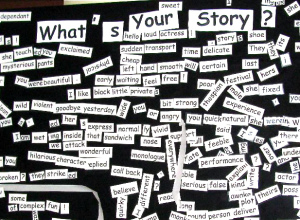


Writing Your Story Helps You Change It

your-story-mattersI guess it’s not surprising that writing about personal experiences has therapeutic value – it’s one reason people keep journals. But I was surprised by the wealth of evidence Tara Parker Pope cites in this article that backs that up, and even more interested in how certain kinds of writing seem to help people solve their own problems – or, to put it in a more positive way, helps them set a course toward achieving what they want.

Pope cites one practice that coaches at the Johnson & Johnson Human Performance Institute use with clients that sounds intriguing. Clients are asked to identify their goals, then write out why they haven’t achieved them. The clients tend to write the usual stories they tell themselves – which often involves pointing fingers at other people or towards outside circumstances they can’t control.

Afterwards, clients are asked to look back at what they’ve written, then edit their stories to produce a more honest assessment of what’s really in their way. In the second version of the story, they’re more likely to come up with reasons that involve the choices they’re making or attitudes or beliefs they’re harboring that they may not have been aware of. Confronting those truths leaves them better positioned to make a change.

It makes perfect sense. Our initial explanations tend to be somewhat defensive – we’re reluctant to look at our own contribution to a situation, because it’s usually a little painful to acknowledge our own responsibility. The result, though, as I see with many of my clients, is that people end up feeling stuck – wedged into some place they don’t want to be by forces they see as outside their control.

Working with a coach is one way of getting some perspective on all this: a good coach will encourage you to consider different perspectives on a given situation, and to confront some of what might be underlying your feeling of stuckness (if that’s a word) so you see your own role. But writing it all down is something you can do on your own, anytime. The commitment of writing forces us to tell our whole self-justification story from beginning to end. It then also allows us to see that story separately from ourselves, as just a story. Once it’s written down, we can step aside and look at it more objectively. And once we’ve gotten a little distance from it, we’re more likely to see what in that story is not really true. And it’s from there that real change can begin.

The Little Engine That Could

Keep-Moving-Confucius-500x500When I read David Sedaris’s piece in The New Yorker recently about his obsession with his FitBit, I thought it was a little silly. Sure, the little black wristband that counts your steps could make you slightly compulsive about your activity levels, but his story about running around England picking up garbage while he clocked 30,000 steps a day seemed really over the top.

Then, on my birthday, my partner gave me a fitness bracelet as a present. I guess I’d expressed interest in them, mostly in the fact that they count your sleeping hours (and quality of sleep) as well as the number of steps you take in a day, and I thought that could be good to know.

Little did I know that once I put it on, I would feel like a little engine had been strapped to my wrist. Suddenly, I had more energy: I wanted to climb those extra flights of stairs I thought were a drag before, and getting off the subway three stops early seemed like an opportunity more than a way to risk being late to a meeting. When I found myself clocking in at 173% of my 10,000-step goal, I was thrilled. David Sedaris was onto something.

I’m not encouraging fitness bracelets or obsessing over how many steps you take each day – though I do believe moving and fitness are really important. But it’s interesting how just wearing a little rubber wristband has changed my activity level – and gotten me to make extra efforts to try to get in 8 hours of sleep. These are goals I’ve set for myself: no one else is counting, or watching, or cares. But it tells me something about the power of setting personal goals, and of having something that consistently calls my awareness to them – even when it involves an activity that in the past I’d pretty much taken for granted.

It also tells me something about the power of perspective: instead of seeing the stairs to my apartment as an exhausting and unfortunate aspect of where I live, I now see them as a fitness opportunity: a chance to boost my step count.

So what if I shifted my perspective on other things in my life, beyond how many steps I walk in a day? What if, for example, when I wake up in the morning, instead of feeling weighed down by the pressures and obligations of the day ahead, I consciously choose to set those thoughts aside and contemplate five things I’m grateful for? Those things could be as simple as my morning cup of coffee, my dog snoring next to me, or just being alive. It’s amazing how quickly they come once you start counting them, and the internal change that occurs from focusing on that gratitude for a few moments. From that mindset, I can set one positive goal or intention for the day – say, practicing patience or compassion. With that goal in mind, my day’s responsibilities are no longer a drag; they’re an opportunity to practice.

In The Buddha Walks Into the Office: A Guide to Livelihood for a New Generation, Lodro Rinzler writes: “Knowing your intention for what you do is the difference between schlepping through your life and living a life with meaning.” Rinzler recommends contemplating an intention for the day each morning, and checking in with yourself at the end of the day to see how you did. The idea isn’t to berate yourself if you didn’t follow through, but simply to be aware of what you did, consider how it felt, appreciate your successes and decide whether you want to do something differently next time. The next day is another opportunity. You can write down your day’s intention someplace where you’ll see it during the day to ensure you keep it in mind.

We all need — and can create for ourselves — regular reminders to follow through on our best intentions. And while someone’s making a lot of money off that FitBit idea, our reminders don’t need to involve a hi-tech rubber bracelet.