
Time Out

imagesI’ve written almost nothing on this blog since the inauguration of Donald Trump. Partly I think it’s because I’ve been so outwardly focused – fixated on the daily, minute-by-minute news of the disturbing, twisted, often absurd machinations of this new administration that I haven’t taken the time to stop and think much. When I have, usually because all my anger and frustration has exhausted me, what surfaces is primarily a sense of defeat, resignation, and depression.

The other reason I’m not writing is because I’ve been seeing the world around me as rapidly deteriorating, so everything else seems trivial. I just haven’t been able to muster the energy to think of something positive or hopeful or encouraging to write about. And nobody needs more bad news to read. There’s plenty of that available already.

Of course, when I do stop to think about it, I’m not actually seeing the world deteriorate.  I’m reading, watching and hearing about it. It’s the focus of the news, of my Facebook and Twitter feeds, of ordinary conversation with friends, neighbors and colleagues.

What I’m actually seeing on a day-to-day basis hasn’t changed that much — except maybe the buds bursting up in February or the snowstorms in mid-March, which were definitely disturbing.  Still, most of what I’m seeing is exactly the same as what I saw when Barack Obama was president:  the same buildings and trees outside my window, the same people and dogs on the street, save for a new baby or puppy that’s recently arrived. My physical and visual world, my own life circumstances, haven’t really changed much.

Of course, lots of other peoples lives have changed, especially if they’re undocumented immigrants or Muslim, and I recognize that I’ve been shielded from the immediate effects of Trump’s policy changes by my relative social privilege.

Still, it’s amazing how much our consciousness and sense of the world and of ourselves in it can change based on what we’re reading, watching or listening to: the material our minds consume.  On the one hand, it’s wonderful that we can access news from all over the world in such an up-to-the-minute way and know what our government, for example, is doing. On the other hand, having that option can really take us away from ourselves, what we want and care about, and from doing the things and living our lives in ways consistent with that.

In “Life Without Principle,” Thoreau wrote: “We should treat our minds, that is, ourselves, as innocent and ingenuous children, whose guardians we are, and be careful what objects and what subjects we thrust on their attention.”

As the Buddha taught, what we frequently dwell upon determines the shape of our mind.

Many of us can’t just turn off the news, of course, and I don’t think we should.  We need to know what’s happening in our political system, and the real consequences it has for millions of people, and for the entire planet, to even begin to try to change it. But taking time to reconnect with ourselves is also key to staying in touch with what’s important to us and to recognizing our own inner strength and resources, despite the mayhem in the political world.  It’s also key to refueling — we need to re-connect with a sense of peace, with joy, with beauty, in order to replenish the energy it takes to continue fighting against these larger forces that threaten to overtake our better natures.

In Harper’s this month, Walter Kirn writes of driving from Western Montana to Las Vegas, without looking at or listening to the news the entire time. He finds it eye-opening, revitalizing, and oddly political: “In a supposedly post-factual time, deep attention to the passing scene is a radical act, reviving one’s sense that the world is real, worth fighting for, and that politics is a material phenomenon, its consequences embedded in things seen.”

I learned recently of the death of an acquaintance, someone I knew slightly but not well, and it struck me that even in our occasional encounters, he had touched me deeply.  I remember him as open, kind, gentle and wise — all qualities I admire, and would like to have more of.

We don’t tend to think about it, but we influence other people all the time, through even our most ordinary interactions. Taking time away from the public drama to reconnect with ourselves seems key to understanding that, and to reminding us that we can choose how we relate to the world. And that’s really the only way we can even attempt to leave our best impression on it.

Learning from Silence

images.pngThere’s nothing like a 7-day silent retreat to shut you up. I don’t mean just during the retreat, when, of course, you’re supposed to be quiet. But even after. I’ve found that since returning from a week-long meditation retreat in July, I’ve been reluctant to write. Not about public affairs, which I write about for my work, but about the experience of the retreat itself. Seven days of silence taught me not only the value of silence, but why it’s really worth evaluating more carefully what it is we have to say.


Being in a room with 100 other people in silence makes immediately clear how much anxiety underlies ordinary situations involving other people simply because we feel we should say something. Preferably it’s clever, witty, or welcoming, and always it feels like a reflection of us in the world. The worry, ‘How will I present myself?’ Is frequently an anxiety about ‘what will I say?’ It leads to a lot of unnecessary chatter, which in itself can provoke further anxiety.

What’s interesting about being in silence is you find you don’t really need to say much. There’s great peace in that.

Of course, your thoughts don’t stop. You’re just saying them to yourself. This presents a unique opportunity to observe what it is that you say to yourself all day, and its impact.

For example, I noticed that, when undistracted by chatter or radio or television or even reading or writing – all things taboo on a silent retreat – my mind tends to either ruminate about the past or plan for the future. It may be ruminating about why a past relationship went wrong or something I regret saying or doing yesterday or 20 years ago, or it may be planning my next vacation, or even my next meal. But it becomes instantly clear how hard it is to keep my mind in the present.

So what? Well, for one thing, it means I’m missing out on whatever’s going on right now. Which is actually where I’m living my life. It means I’m not fully engaging with the experience I’m having, whether it’s pleasant or painful.

That also means I’m not learning from it. Paying attention to what brings us joy, for example, is really important. How else can you not only fully experience that joy, but know what it is you really want more of in your life?

Paying attention to what’s painful is harder, but also crucial. If I’m feeling bad about some past mistake I made yet again, I can recognize the pain in that and decide to respond to myself with compassion instead of blame. That makes it easier to see, consider and understand why I did what I did, and leaves me better able, when a similar situation arises again, to choose a different course. Over time, choosing to respond this way becomes a new habit. It’s ultimately a much less painful and more constructive way to move forward.

The other thing I realized is how much all these ruminations and plans are really about trying to solidify a sense of who I am: if I’m stewing over something hurtful I did or said, I’m not only regretting that act, I’m also hating myself for being the person who committed it. Identifying myself as a person who does hurtful things compounds the pain tremendously.

The same is true when thinking about other people. If I’m revisiting a wrong done to me, I’m usually not just upset about what happened. I’m also feeling angry toward the person who did it, and whom I’ve now labeled a bad person. And I’m identifying myself as a victim in the situation, which is inherently disempowering. I’ve just compounded the problem and seared into my memory these solid impressions of who everyone involved actually is.

What’s useful about silence is to see how these are all simply habits of mind. We habitually seek to create a sense of our own identity, and of the identity of others, based on partial memories, refracted images and imagined futures. That’s not only painful, but terribly limiting.

What we dwell upon becomes the shape of our minds. In our ordinary lives, we’re being constantly bombarded by stimuli that literally shape our minds, whether it’s the latest hateful thing Donald Trump said or an ad for some luxury item we don’t need and can’t afford. By recognizing this, we can begin to make the choice to focus on things that matter more to us, such as the people in our lives or a cause we really care about. That all requires paying attention to where our minds habitually stray, and setting an intention to direct them toward where we actually want them to go.

Silence helped me realize how much room we have to create our selves, and how much more charitably we can view other people — in far more helpful and responsible ways.

How To Be Of Service

imagesI belong to a local food co-op, and for the privilege of buying really good food at reasonable prices, all members have to work there once a month. Although I usually whine about it before I actually head over there to do my evening shift, once I’m working, I often find it feels like the most useful thing I’ve done all day. Given that I have a “serious” day job as a lawyer for a human rights organization, that might sound odd. But honestly, stocking fresh apples or bunches of kale can feel a lot more real and productive than responding to e-mails, drafting press statements or monitoring Congressional or judicial hearings.

“As far as I’m concerned, every last one of them can rot in hell,” was Senator Tom Cotton’s memorable remark at the last Congressional hearing I watched, which focused on the fate of the remaining prisoners at Guantanamo Bay, half of whom are already cleared for release. Sadly, no amount of outrage I or anyone else expressed was going to change that he and many people in this country feel that way.

Maybe it’s the cold (or the new Republican Congress) that’s gotten me feeling defeatist about my advocacy work lately – it’s dipped below zero lately with the windchill factor here in Brooklyn – but I’ve been wondering a lot about what it means to be useful. I remember a yoga teacher once telling a class I was in that her purpose in life was “to be of service.” That’s stuck with me.

Of course, many people share that goal, and there’s lots of social science supporting the idea that helping others supports our own happiness. But that still leaves the huge challenge of figuring out how each of us can best do that. Where does our unique combination of talents, skills, interests and circumstances lead? Where and how can each of us be most useful?

The answers are different for everyone, and may keep changing over the course of our lives, but here are five things to consider as guidelines.

  1. Helping shouldn’t make you miserable.

This may sound like a no-brainer, but it’s easy to go down a path you thought would provide a real service that you then find you can’t stand. When I started out as a lawyer, for example, I was thrilled to get a job with a child welfare advocacy organization. We brought huge class-action cases representing hundreds of thousands of kids at risk of abuse and neglect around the country. What could be more noble? In reality, I spent most of my time in an office sifting through documents and regurgitating the same legal arguments over and over. I was miserable. It took me time, though, to realize that it’s okay to leave a “good” job that does “good” work if it makes you feel lousy.

  1. Your calling doesn’t land you in the poorhouse.

Some people can afford to do low-paying work that provides a service; others can’t. Taking a job that doesn’t pay you enough to support yourself and your family, if you need to do that, isn’t going to help anyone in the long run. Do work that not only provides a service to others but will sustain you as well.

  1. Your work allows you to take care of yourself.

In addition to providing others a service and you an income, your work needs to allow you the time and flexibility to take care of yourself. I see some people work so hard that between their job and their family responsibilities they end up neglecting their own physical and mental health. When you neglect yourself, you end up neglecting those around you. You can’t offer the best of yourself if you haven’t nurtured yourself in the process. In the long run, this is critical to providing a true service to anyone.

  1. You encounter a sense of flow, effortlessness or timelessness in your work.

The state of “flow” is achieved when “a person’s body or mind is stretched to its limits in a voluntary effort to accomplish something difficult and worthwhile,” says Mihaly Csikszentmihalyi, who coined the term in his 1990 book, Flow: The Psychology of Optimal Experience. The point is that you’re so engaged in what you’re doing that you’ve stopped thinking about yourself, and stopped worrying about the past or the future. You’re just in the moment, doing what you’re doing. It doesn’t feel like “work” anymore, it’s just being. These are precious moments. I get them sometimes when I’m writing, or really connecting with a coaching client. Providing a service to others should provide you at least some moments when you’re totally engaged in that way – whether with another person, an action or a creation. Without that, it will be hard to sustain your commitment.

  1. You feel good about yourself at the end of the day.

This is key. A job may sound important when you describe it at a cocktail party, but when you look back at what you’ve done after a day’s work, how do you feel? Do you feel like you accomplished something, helped someone, participated in an important effort, or otherwise added something to the world around you? Or do you feel like you’ve just wasted your time? Pay attention to that. Providing a real service should feel like you’re providing a service. It may not (and probably won’t be) fun or fulfilling every minute, but after you’ve spent a chunk of time on it, you should feel like you’ve done and contributed something of value. If you don’t, think about that – and consider when you do.

Of course, this is not an exhaustive list, just a few things to pay attention to. And it doesn’t mean you have to immediately quit your job if your work doesn’t meet these standards. But it does suggest you may want to ask yourself what’s really important to you, and how does your life now support those things? How can it better support them?

And if you have any other guidelines you’d like to add to this list, please do! That’s what comments are for.

The Trouble with Branding

brandingSometimes when I see what other coaches write, it makes me want to run the other way. I’m not THAT, I tell myself, wanting nothing to do with the sort of aggressive over-the-top promises and platitudes I see some “life coaches” or “executive coaches” or business consultants using to promote themselves.

Other times, when I look back at what I’ve done all day for my job, whether it’s watching terrorism trials or Congressional hearings and fuming at the state of American politics, I want to scream. I don’t want to be THAT person either, immersed in and getting all worked up over awful things in the world I can’t control.

Of course, if I have some perspective, I can realize that these things all serve some purpose right now, whether it’s helping me find my way in a new field I enjoy, advocating for something I believe in, or just earning a living. But when I’m in the thick of whatever it is, or face embarking on a new project, those inclinations to define myself by what I’m doing at the moment can really get in my way.

Consultants are all about “branding” these days, and the importance of people creating a “personal brand” that tells the world who you are. The prevalence of social media and our “digital footprint” has intensified the pressure, but it even arises in the sort of cocktail-party conversations we have when we meet new people. Marketers will tell you to pull out your “elevator pitch” right then because it’s a perfect opportunity to try to convince someone to hire you — and you’d better not miss any opportunities. Plus there’s the general social pressure to label ourselves as something solid and impressive.

I think it’s exactly this kind of ubiquitous “branding” that leaves many people feeling stuck and hopeless. Lots of us have jobs we don’t love that pay the bills, for example, but we don’t want to “brand” ourselves by it. We’re not cattle. We have lots of other interests, and maybe we’re developing a whole new skill or talent or career on our own time. A public “brand” isn’t going to capture that. It could even limit it.

I was once told by a friend who’s a communications professional that I have a “great brand.” I was flattered – who knew I had a “brand” at all? – but it also had the effect of limiting me. Suddenly I felt like taking a different path I was considering would be foolishly wasting my “brand” – for whatever it’s worth.

The truth is, we’re not one thing, and the complex of our skills and interests and personalities don’t fit neatly into a label or a tagline. To try to cram ourselves into some set form means we’re cutting off other essential parts of ourselves. It prevents us from learning and trying new things, exploring latent talents and interests, and just generally from growing and expanding. It seems to me like a recipe for misery.

Many of my clients seem to struggle with this kind of self-branding pressure. A freelance writer, for example, has an assignment he thinks is stupid, but those assignments pay the bills so he can also do the writing he wants that, for now, at least, is not paying him. As soon as he sits down at his computer to start working on the assignment, though, he balks: I don’t want to do THIS, he thinks; I’m not THAT person, who writes this sort of idiocy. What have I done with my life? Now, he not only has an assignment to do that he doesn’t find interesting, but he’s blocked from getting started because he can’t get over the negative labels he’s slapped on himself for being the person doing it.

The other, related problem with branding is how it interacts with the human tendency, at least in Western culture, to view ourselves negatively. I make a mistake so I immediately call myself “stupid,” for example. Or I eat or drink too much and now I’m a person with no self-control. We tend to label ourselves negatively at every opportunity, and that labeling actually makes it much harder to change. Seeing ourselves as fixed and “branded” entities only digs us deeper into that hole.

Stephen Cope talks about this in his book, The Wisdom of Yoga, which I’ve written about here before. Instead of seeing human beings as fixed, solid entities, Cope explains, Yogis (much like Buddhists) discovered that we’re composed of many different “patterns of consciousness,” which may or may not fit well together. “It is partly the driven attempt to make all of the pieces fit nicely together that keeps us so often at right angles to life,” writes Cope. Yogis found that clinging to an idea of a unitary self causes suffering because it narrows our sense of who we are and makes us very small in comparison to the rest of the world. Now we have to defend “ourselves” against that world, and exert huge amounts of energy bolstering our egos in the face of it.

This can be particularly tiring when we’re dealing with parts of ourselves we don’t really like. If we see ourselves as a solid entity, then it’s extremely painful to confront our mistakes or bad habits. Because we see them as us. We take them very personally. As a result, we tend to avoid confronting those parts, and the habit continues.

If, on the other hand, we see ourselves as various and intersecting patterns of consciousness that are constantly growing and changing, then past mistakes or habits can feel a little less solid. They’re a pattern we’ve developed, not an essential part of our character. It’s not so scary now to look at them, to notice what triggers them, and to see how and where we can interrupt the chain reaction. And it’s only when you can see and accept that part of yourself without judgment, as Cope explains, that you can begin to take steps to change it.

What does this all have to do with branding? Branding seems to me to be a trend towards doing the opposite: a call to define and present ourselves as solid and unchanging entities, available on demand for perfect presentation and sale — and then to act accordingly. Just writing that makes me feel like I’m choking.

Of course, if you’re trying to start a new business or change one, developing a brand can help let people know what you offer. But personal branding is far more than that – it’s carefully crafting your own presentation to the world, which in turn can become how you lead your life. It’s turning yourself into a commodity available for sale in the marketplace, rather than acknowledging and relishing being a multi-faceted human being who has far more to offer than you probably realize.

In other words, branding is fine in its place, but it’s not you:  you’re much more. As Walt Whitman put it: “I am large, I contain multitudes.”

Writing Your Story Helps You Change It

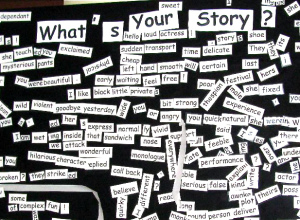
your-story-mattersI guess it’s not surprising that writing about personal experiences has therapeutic value – it’s one reason people keep journals. But I was surprised by the wealth of evidence Tara Parker Pope cites in this article that backs that up, and even more interested in how certain kinds of writing seem to help people solve their own problems – or, to put it in a more positive way, helps them set a course toward achieving what they want.

Pope cites one practice that coaches at the Johnson & Johnson Human Performance Institute use with clients that sounds intriguing. Clients are asked to identify their goals, then write out why they haven’t achieved them. The clients tend to write the usual stories they tell themselves – which often involves pointing fingers at other people or towards outside circumstances they can’t control.

Afterwards, clients are asked to look back at what they’ve written, then edit their stories to produce a more honest assessment of what’s really in their way. In the second version of the story, they’re more likely to come up with reasons that involve the choices they’re making or attitudes or beliefs they’re harboring that they may not have been aware of. Confronting those truths leaves them better positioned to make a change.

It makes perfect sense. Our initial explanations tend to be somewhat defensive – we’re reluctant to look at our own contribution to a situation, because it’s usually a little painful to acknowledge our own responsibility. The result, though, as I see with many of my clients, is that people end up feeling stuck – wedged into some place they don’t want to be by forces they see as outside their control.

Working with a coach is one way of getting some perspective on all this: a good coach will encourage you to consider different perspectives on a given situation, and to confront some of what might be underlying your feeling of stuckness (if that’s a word) so you see your own role. But writing it all down is something you can do on your own, anytime. The commitment of writing forces us to tell our whole self-justification story from beginning to end. It then also allows us to see that story separately from ourselves, as just a story. Once it’s written down, we can step aside and look at it more objectively. And once we’ve gotten a little distance from it, we’re more likely to see what in that story is not really true. And it’s from there that real change can begin.